Conversion Psychology
Sellable Article

AI Ad Copy That Converts: A Guide to Performance Marketing in 2025

Sellable Team · January 28, 2026 · 7 min read
Sellable Blog

Why copy is the most underrated lever

Most brands spend 80% of their creative budget on visuals and 20% on copy. But split-test data consistently shows that copy variations drive as much lift as creative variations — sometimes more.

A strong headline can double click-through rate on the same image. A specific CTA ("Get 40% off this week only") outperforms a generic one ("Shop now") by 30–50% in most categories. The difference between "Free shipping" and "Free next-day shipping" can swing conversion rate by 15%.

Despite this, most brands treat copy as an afterthought — written once, rarely tested, almost never scaled.

How AI copy generation works

Modern AI copy generators are language models fine-tuned on hundreds of millions of high-performing ads across Meta, TikTok, Google, and email. Unlike general-purpose LLMs, ad copy models understand platform conventions, character limits, emotional frameworks, and conversion psychology.

You provide: - Product description and key benefits - Target audience (demographics, interests, pain points) - Tone and brand voice - Platform and format (headline, primary text, CTA, etc.)

The model generates multiple variants in seconds — different angles, emotional hooks, levels of urgency, and CTA phrasings.

Platform-by-platform guide

Meta (Facebook & Instagram)

Meta ads reward emotional resonance and social proof. The highest-performing formats:

  • Pain-agitate-solve: "Tired of $3,000 photoshoots that take weeks? [agitation] Our brands are generating studio-quality product photos in 60 seconds. [solve]"
  • Social proof hook: "500+ brands switched to AI photography this year. Here's why they haven't looked back."
  • Curiosity gap: "We showed an AI a photo of our product. What it generated shocked us."

Keep primary text under 125 characters for mobile — anything beyond that gets truncated above the fold.

TikTok

TikTok copy requires a completely different voice — casual, direct, and native to the platform. What works:

  • Pattern interrupt: Start with something unexpected. "Nobody talks about how expensive product photography is for small brands. Until now."
  • First-person narrative: "I run a Shopify store and I used to spend $2,000 on photos. Then I found this."
  • "POV" framing: "POV: You're a brand owner who just discovered AI product photography"
The Sellable Platform

Free tools are
just the start.

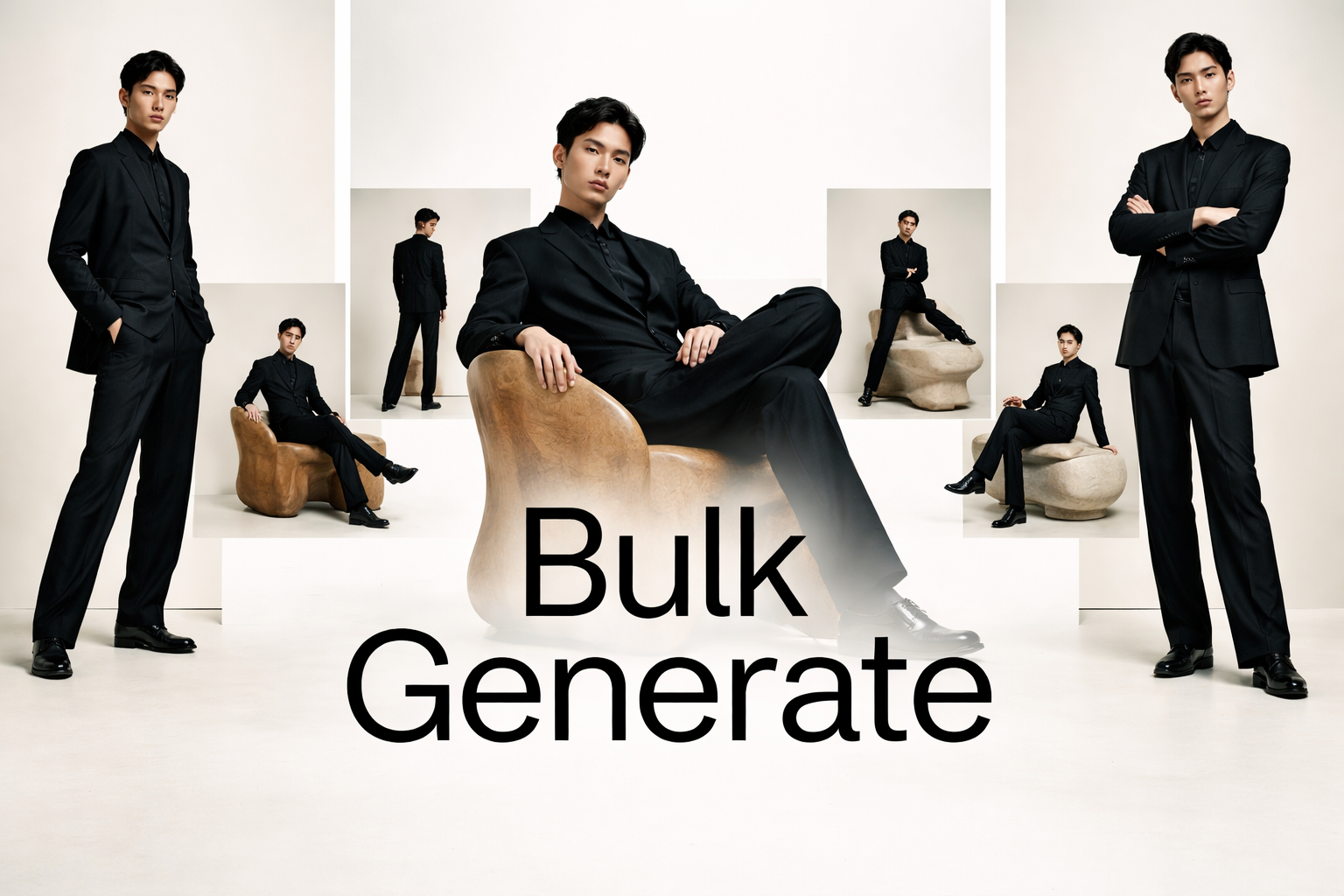
Sellable's platform turns a single product photo into studio-quality images, cinematic video, and on-brand campaigns — generated, refined on the canvas, and published straight to your store.

Studio photos & video from one product image
Train your brand style for consistent output
Bulk-generate and push to Shopify in one click
Get started free →
My Brand · Studio Generate
✓ On-brand

TikTok character limits are generous, but front-load your key point — users decide whether to engage within 2 seconds.

Google copy is intent-driven. Your copy competes against others targeting the same keyword, so specificity wins:

  • Include the keyword in the headline: "AI Product Photography — From $149/mo"
  • Lead with differentiators: "10× Faster. 90% Cheaper. Studio Quality."
  • Use numbers: Specificity ("500+ brands", "60 seconds", "7-day free trial") consistently outperforms vague claims

The A/B testing framework

The most effective AI copy workflow is iterative:

Round 1: Generate 10–15 variants across 3 distinct angles (e.g., speed, cost, quality). Run as a broad test with equal budget.
Round 2: Identify the top 2–3 performers. Use them as seeds for the next generation — ask the AI to "write 10 variations of this winning ad" with specific modifications (stronger CTA, different hook, etc.).
Round 3: Narrow to 2–3 champion variants. Run at scale. Use learnings to brief human copywriters for longer-form content.

This framework typically yields a 3–5× improvement in ROAS over a single static creative within 4–6 weeks of structured testing.

Prompting for better copy

The quality of AI copy output is highly sensitive to prompt quality. A few principles:

Be specific about your customer: "28-year-old female founder of a skincare brand, spending $2k/month on product photography, frustrated by slow turnaround" → much better output than "small business owner".
Give the AI a winning example: Include a piece of copy that's worked well for you before and ask it to "write 10 variations with a similar tone".
Specify what to avoid: "Don't use the word 'revolutionary'. Avoid exclamation marks. Don't mention competitors by name."
Request emotional tone: "Write this with a tone of quiet confidence — not hypey, not salesy, but compelling."

Start generating AI ad copy with Sellable →

ad copyAI copywritingMeta adsTikTok adsperformance marketing
More Articles
Free Tools

Ready to get started?

Sign up for free and transform your product photography with Sellable.

Get started for free